

When a family comes apart, the children rarely have a voice in the room where their future is decided. Our firm’s whole approach to custody work is built around changing that, and around staying current with the research, methods, and professional practices that actually help children come through a separation intact.
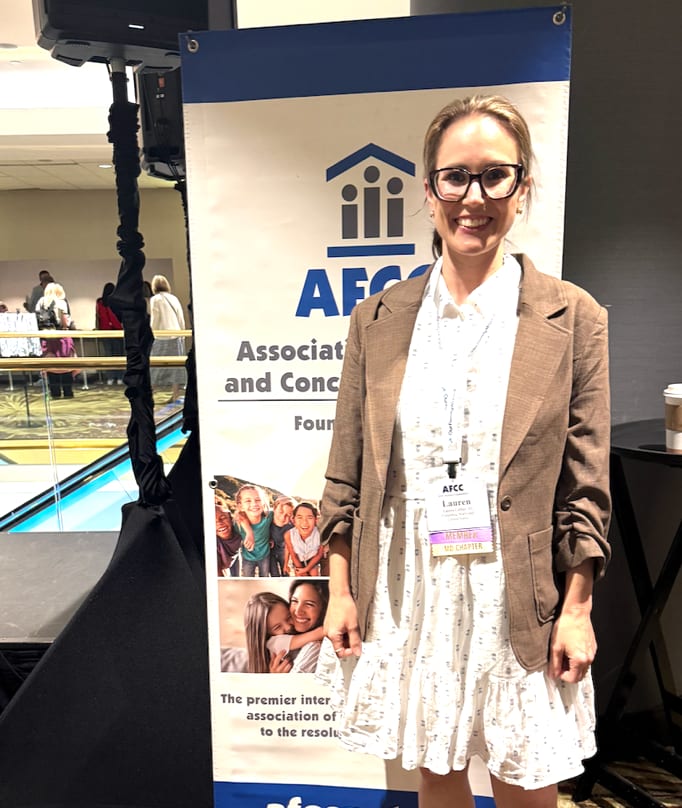
Our firm’s managing partner, Lauren N. Leffler, recently spent several days at the annual conference of the Association of Family and Conciliation Courts (AFCC) in Seattle, the leading interdisciplinary organization for family-court professionals, including judges, lawyers, evaluators, mediators, parenting coordinators, and mental-health experts. We go to these types of conferences because the best custody work is no longer just about who “wins.” It is about understanding child development, mental health, attachment, neurodivergence, and family systems well enough to design parenting plans that genuinely serve the child. In addition to being able to enjoy the sights, sounds, and tastes of Seattle, Attorney Leffler was able to take away new ideas and innovative approaches for how Leffler, Bayoumi & Oliver, LLC, represents families.
How do we make sure the child is actually heard?
A pre-conference session on hearing the voice of the child reframed something we feel strongly about in our work as child counsel. Including a child in the process, in an age-appropriate way and consistent with local practices, can build their trust in the system and their own sense of self-worth. The goal is not to interrogate a child or to make them choose. It is to listen well, to talk with them rather than at them, and to relieve them of the burden of carrying issues silently, what one presenter memorably described as helping a child set down the rocks they have been carrying.
Done thoughtfully, an interview of a child should be a non-forensic activity that uses curiosity and flexibility rather than a fixed script. Skilled child counsel can use expressive and play-based methods that give children a safe distance from a hard topic and let them show, rather than have to explain, what matters to them. Children often worry about whether the decision-maker actually cares what they think and whether they can “get it right.” A good process reassures them on both counts. It also resists the temptation to pathologize a child who expresses mixed feelings. A child saying “sometimes I like it there [at a parent’s house] and sometimes I don’t” is healthy, not a problem to be solved.
What we take from this is practical. We look for opportunities to keep a child’s real experience connected to the decisions being made, while keeping that child out of the adult conflict and away from any sense that they are responsible for the outcome.
Is this parent in crisis, or actually unfit?
Divorce is one of the most disruptive events a person can go through, and it is normal for otherwise capable parents to show intense anger, grief, fear, or anxiety during it. As the saying among family-court professionals goes, in criminal court you often see difficult people on their best behavior, while in family court you see good people at their worst. The healthier outcome is resilience, building coping skills to move forward, rather than mere adaptation, going numbly through the motions. Part of the work is validating a parent’s anger while helping them channel it, so it does not spill into the children’s lives or alienate them from the other parent.
At the same time, real mental-health and substance-use concerns sometimes need to be addressed for a child’s safety, and a referral to a qualified professional is warranted when a parent’s daily, social, or occupational functioning is genuinely impaired. Lawyers are not clinicians, so we know how to make a respectful referral, explain the reason for it, and account for the stigma many people feel about a diagnosis, without sharing so much about the case that we contaminate the therapeutic relationship. A central insight we carry into every case is that what matters is rarely the diagnosis itself, but its impact on parenting, things like inconsistency, dysregulation, inflexibility, or a child who ends up taking care of the parent.
Why do reasonable people get so stuck?
The most useful framework we encountered came from a session on divorce from the perspective of detachment, which uses adult attachment principles to understand why some cases get stuck in impasse. The premise is that family law is not only about reason and reasonable people. Separation is one of the most stressful experiences a person can go through, and people in that state are confused, agitated, and unsure how to get unstuck. Attachment gives us a way to understand the loss, grief, and emotional turmoil underneath the conflict, so we can find a pathway forward without pouring fuel on it.
Adults experience attachment to their small inner circle of people we rely on. When someone from that inner circle moves outside it, it does not just end a relationship, it unsettles our identity and our sense of who we are. The real difficulty in many cases is not disagreement about a schedule. It is that one or both people are struggling to detach. As one presenter put it, the opposite of love is not hate but a kind of acceptance, and partners often arrive at that point at different speeds, one with both feet still in the relationship and the other halfway out.
This reframes what “stuck” means. One way to read an impasse is that a person is simply stubborn, manipulative, or acting in bad faith. Another way, the one we find far more accurate and useful, is that the person is experiencing active loss, threat activation, mistrust, unresolved grief, identity disruption, and a fear of being erased or not respected as a parent. Some people would rather keep fighting in court than lose the connection entirely, because the conflict is the last thing still tying them to the other person.
Seen this way, the surface fights carry deeper meaning:
- A dispute about exchange time can really mean “Am I being erased?”
- A fight about flexibility can mean “Can I trust the other parent?”
- A clash over decision-making can mean “Will I be controlled or excluded?”
- A holiday-schedule battle can mean “Do I still belong in this family?”
- A conflict over school communication can mean “Am I still a real parent?”
- An obsession with documentation can mean “How do I protect myself?”
Attachment patterns tend to activate only in times of distress, and separation is a massive activation, made worse because the person someone would normally turn to for reassurance and emotional safety is now the source of the threat. Research suggests it can take only about six months to form an attachment but two to three years to truly detach, and that people with more fearful or insecure patterns are more likely to land in high conflict and prolonged litigation, because their underlying needs are never met by the fight. Notably, the presenter cautioned against labeling anyone with a specific attachment style. That can be pathologizing, and different styles can be appropriate in different cultures. The more useful move is to look past the secondary emotion, usually anger, to the primary emotions underneath it: fear, worry, and concern.
So what do we do with this? We aim to build stability before trying to resolve substance, because problem-solving improves once people feel less threatened. Three anchors guide that work: safety (physical, emotional, relational, and procedural), responsiveness (timely, attuned responses), and predictability (clear routines, expectations, and timelines). A specific, predictable parenting plan is one of the most powerful tools we have, because the legal process itself, with its unknowns and delays, is a threat that keeps people activated. We also watch for the protest-withdrawal cycle, where one parent pursues and demands while the other withdraws and avoids, which escalates until both are entrenched. Recognizing that pattern lets us interrupt it. And we keep in mind that separation is the highest-risk period for family violence, because the power dynamics have shifted, so structure and safety planning are not optional.
Children feel all of this. When the coparenting relationship is strained, kids often try to restore balance by getting pulled into the middle, and they carry vigilance, over-responsibility, loyalty binds, and dysregulation as a result. The most important thing this teaches us is simple: when we improve the relationship between the parents, we improve the relationship between each parent and the child.
What keeps people locked in the fight?
The conference keynote, delivered by James Kimmel Jr., J.D., on the neuroscience of revenge and forgiveness, gave us a striking way to understand why some custody disputes seem to take on a life of their own. His research suggests that the brain on revenge looks a lot like the brain on addictive drugs. When we have been hurt, striking back at the person who hurt us, or at a stand-in for them, lights up the brain’s reward circuitry and feels good. The trouble is that the relief is short-lived, which is exactly how an addiction behaves. Even lawyers, he noted, can recognize the small “wins” that feel satisfying in the moment but never quite last.
A few of his points map directly onto family court. Much human conflict is driven by grievance, whether real or only perceived, and a great deal of harm is what he calls revenge by proxy, taking the pain out on someone who did not cause it. In a divorce, that proxy is too often the children or the legal process itself. Because the pattern behaves like an addiction, the tools used to treat addiction may help interrupt it, and forgiveness, far from being soft, functions almost like detox: it calms the brain, reduces the pain, quiets the reward-seeking, and restores the executive functioning and self-control that grievance hijacks.
We are not therapists, and there are times when vigorous litigation is exactly what a child’s safety requires. But we do help clients tell the difference between strategic legal action that protects their family and grievance-driven escalation that drains their resources, prolongs the conflict, and harms the very children it claims to be about. Helping a client find a path toward resolution, and sometimes toward letting go, is usually far better for them and for their kids than feeding a cycle that never satisfies.
What about families who are wired differently?
A session on neurodivergent families in the legal system reshaped how we think about a growing number of our cases. Neurodivergence, which includes autism, ADHD, and learning differences, refers to the way a brain is structured from birth. It is distinct from a mental-health disorder, even though the two can co-occur, and identifying it matters, because a missed diagnosis can lead to emotional neglect or trauma for a child.
For an autistic child or parent, sensory experience can be overwhelming, with everything from a breeze to an important instruction felt at the same intensity, which makes organizing and expressing thoughts hard. Behaviors like stimming are ways of self-regulating, and many people, especially those who mask their traits, are constantly suppressing part of themselves at real cost. Social awkwardness usually reflects difficulty reading a flood of social cues, not a lack of care. The practical implications for a parenting plan are significant. For families with autistic children, joint decision-making should usually be the exception unless they have shown they can make fast decisions together, and any move toward a 50/50 schedule needs very long on-ramps and substantial scaffolding. The priorities are reducing transitions, reducing conflict, and giving the child plenty of time and support before any change, and a conventional public-school setting may not always be the right fit. Sometimes siblings even benefit from different schedules. One caution stuck with us: do not assume the neurodivergent parent is the problem, because autistic women, in particular, can sometimes be drawn into relationships with partners who exploit them.
ADHD involves the executive-functioning system, and its effects, including significant emotional dysregulation, should never be downplayed. Children with ADHD do best with loving, affirming, consistent caregivers and with parental scaffolding that actively teaches skills, such as executive function and emotional regulation, that are not usually taught directly. A parent with unmanaged ADHD should get treatment and, where useful, coaching, and emotional reactivity in a parent should be taken seriously rather than minimized. We also pay attention to AuDHD, the combination of autism and ADHD, often co-morbidities, where the two profiles pull in nearly opposite directions and the zone in which a person can function comfortably is very narrow.
Learning disabilities call for their own attention, including early testing, which is critical to avoid long-term harm to a child’s self-worth, plus practical planning around tutoring costs, specialized schools, and summer scheduling. Across all of these, a few principles guide us: de-stigmatize and de-weaponize diagnosis and treatment, never penalize a parent for seeking help, and encourage parents to get professional input on the plan. Orders for neurodivergent families generally need what looks like excessive detail to actually work, and these plans are unlikely to stay fixed for the long term. We also remind clients that courts must provide ADA accommodations, so a neurodivergent client may be able to request breaks or other adjustments, and that being handed a document to absorb on the spot in a courtroom can be genuinely overwhelming.
What makes a parenting plan actually work?
A session on drafting plans with specificity and accountability confirmed something we see constantly: vagueness is where high-conflict cases are born. When a plan is unclear, the higher-conflict parent fills the void, and each side can claim a different interpretation, always to the children’s detriment.
The fix is to draft for the family you have now and the family you may have later, and to match the level of detail to the level of conflict. Phrases like “communicate as needed,” “parents will jointly decide,” and pickup “around 6 p.m. at a convenient place” are invitations to dispute. They let one parent stall, over-communicate, withhold information, or delay a decision until it no longer matters. In a high-conflict case, we spell out timing, processes, responsibilities, and consequences in advance, and we build in clear communication protocols, notice requirements, deadlines, and defined interventions for non-compliance. In a lower-conflict case, the same care produces a durable plan that simply works, because there is no parenting-plan police unless you write one into the order.
This pairs naturally with thinking about risk and protective factors. Children in high-conflict separations face stacking risks, including ongoing exposure to conflict, loyalty binds, unpredictable transitions, and instability. The research is just as clear about what protects them. The single most important protective factor is at least one stable, nurturing relationship, that dependable secure base again, alongside being shielded from the adult conflict, consistent routines, child-centered coparenting, and parents who can regulate their own emotions. A good plan is engineered to reduce a family’s specific risks and strengthen its protective factors. That sometimes means challenging the assumption that a textbook “developmentally appropriate” or symmetrical schedule is automatically best, because for some children, especially neurodivergent or younger ones, stability and routine matter more than equal time on paper. And because children grow and circumstances change, we treat parenting plans as living documents to be reviewed as new information comes in, rather than something etched in stone.
When parents truly cannot work together, what then?
For the highest-conflict families, two tools stood out. The first is parallel parenting, designed specifically for parents who cannot cooperate. It treats them less like collaborators and more like business partners running separate households. Day-to-day decisions are made exclusively by the parent who is on duty, major decisions are divided by domain, communication is in writing only through a coparenting app or a shared log, and the schedule favors minimal transitions with longer stretches of time, such as week-on/week-off. It is a harm-reduction model that gives each parent a separate sphere to heal and parent in, with clear boundaries, narrow and explicit rules, and no informal right of first refusal. It is meant to be time-limited, with regular reassessment and a graduated path toward more cooperative coparenting if and when the parents are ready, and it requires individualized assessment and added safety planning where there is any history of family violence.
The second is skilled parenting coordination. A good parenting coordinator can take day-to-day conflict off a family’s plate and intervene decisively, focusing on consistency within each household and on building the children’s own skills, like emotional regulation and distress tolerance, rather than refereeing every disagreement. Two principles from that discussion stay with us. Sobriety is not the same as recovery, which also requires coping skills, a relapse-prevention plan, an aftercare plan, a support system, and accountability. And the goal is always the least restrictive intervention that still preserves safety and protects relationships. Throughout, the child should never be made the messenger or the informant between parents.
Why does this matter for your family?
Staying on the leading edge of family-law practice is not about jargon or credentials for their own sake. It is about results for children. A lawyer who understands attachment can see the fear underneath the anger and help a client get unstuck. A lawyer who understands neurodivergence can keep a capable parent from being mischaracterized and can build a plan that actually fits how a family is wired. A lawyer who can tell distress from dysfunction protects a good parent while still recognizing genuine safety concerns. And a plan drafted with real specificity gives a child the stability and predictability that all of the research says they need.
That is the standard we hold ourselves to in every custody, divorce, parenting-coordination, and mediation matter we handle: keep learning, stay current, and keep the child at the center of the plan.
Talk to us
If you are facing a custody dispute or designing a parenting plan and you want a firm that brings a current, child-focused approach to the table, contact Leffler, Bayoumi & Oliver, LLC, at 410-740-1180 to schedule a consultation. We will help you build a plan that holds up, and that puts your child first.
Need Legal Assistance?
If you have questions about this topic or need legal representation, our experienced attorneys are here to help. We work with clients throughout Maryland to provide practical guidance and effective advocacy.
Contact us to discuss your situation and learn how we can assist you.